Indice
Setting the Culture Right for New Hires
WHAT DOES YOUR HANDBOOK ACTUALLY SAY ABOUT YOUR CULTURE?
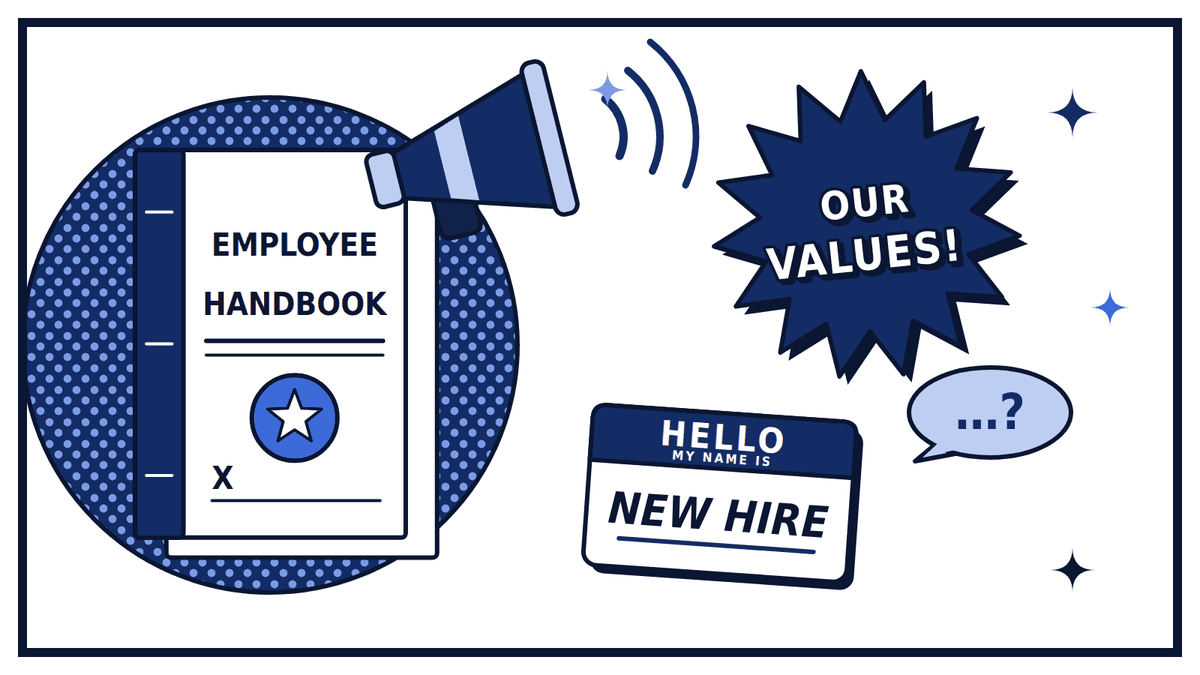
Somewhere in your company's shared drive is a document almost nobody reads twice: the employee handbook. Most people skim it once during onboarding week, somewhere between the parking instructions and the benefits enrolment deadline. Then it sits there for years, updated occasionally by legal.
And yet it might be the most honest culture document your company owns. Not because it's inspiring, but because it doesn't describe the culture you wish you had. It describes the culture you were willing to write down, get legal to approve, and ask every employee to sign.
A handbook can tell you what a company intends. Only continuous, structured listening, reaching every level of the organization, can tell you whether that intention is actually being lived.
Stated Culture
Why Does Stated Culture Matter?
Every handbook opens the same way: a welcome, some company history, a mission and vision, and a values statement. A values section isn't decoration. It's the yardstick employees will, consciously or not, measure everything that follows against.
Compensation and benefits sections build trust through transparency: pay structure, work hours, work-from-home arrangements, and benefits. This section is the hardest to fake, because employees can check it against their own paycheck.
What Forms Does It Take?
Codes of conduct, harassment and discrimination policies, safety procedures, and leave policies show what a company considers important enough to formally define and defend. A detailed anti-harassment policy that spells out reporting channels, investigation steps, and anti-retaliation protections says something specific: if you raise a problem, here's exactly what happens, and here's your protection for raising it.
Psychological safety: the shared belief that it's safe to speak up, raise concerns, or admit mistakes without fear of punishment or humiliation.
How Is It Demonstrated in Practice?
Clear pay structure builds fairness employees can verify for themselves
Detailed anti-retaliation protections signal real psychological safety
Flexible leave policies communicate trust; rigid ones communicate something else
A thin, purely legal section signals the opposite, even unintentionally
What Gets Rewarded
Why Does Performance Management Matter?
If pay and benefits show what a company gives, performance management shows what it expects in return, and what it actually measures. This is where stated culture meets accountability, and where mismatches surface fastest.
What's Stated Versus What's Measured?
A company can call itself developmental and feedback-driven, then define performance almost entirely through infrequent, one-directional annual reviews with little real coaching. Employees experience that contradiction directly, usually well before leadership notices it as a pattern.
What gets measured quietly becomes what gets managed.
How Do You Close the Gap?
How reviews are conducted, how often feedback is given, and how accountability is paired with support say more about a culture of development than any values slide ever could.
Regular coaching and check-ins, not just annual reviews
Accountability paired with visible support
Individual output measured alongside collaborative contribution
Employee Voice
Why Does Listening Matter?
Often one of the shortest handbook sections is employee relations: guidance on raising concerns, suggestion channels, anonymous wellbeing surveys, open office hours, and town halls. It deserves far more attention, because it quietly admits that everything written above it is only the organization's stated intention.
Culture only becomes real once people are given a way to talk back.
Where Does the Gap Widen Fastest?
A handbook communicates culture in one direction, from the organization to its people. Only listening tells you whether it landed as intended. Only around a quarter of managers globally report being genuinely engaged in their own roles, even though they are the ones translating stated culture into daily reality for their teams.
How Do You Close the Loop?
A handbook reviewed only for legal accuracy stays legally sound and culturally stale. Feedback should shape every section, continuously, not just at the annual legal review.
Suggestion channels and anonymous wellbeing surveys
Open office hours and town halls
A regularly dated log of handbook updates, informed by employee input
The Gap Between Intended and Lived Culture
What you say, formalize, reward and protect gets written down once. What employees experience happens continuously and rarely matches the document perfectly. That gap isn't a failure. Some distance between intended and lived culture is inevitable. What matters is whether anyone knows how wide it is, or where it's widest.
In the teams we work with at Leadbacker, the gap usually shows up first in the early months after joining, when new hires compare what they were told with what they experience. Regular pulse check-ins make that gap visible while there is still time to act.
“"Now that you've been here a few weeks, where has our culture matched what you were told, and where hasn't it?"”
FAQs
What does an employee handbook reveal about company culture?
It reveals the culture a company was willing to write down and formally commit to, not necessarily the one employees live. Values, pay transparency, anti-harassment protections, and leave policies show what the organization considers important enough to define and defend, and they set the standard employees measure everything else against.
How do you close the gap between stated and lived culture?
By listening continuously, at every level of the organization, rather than once a year. Some distance between intended and lived culture is inevitable. What matters is knowing how wide the gap is and where it's widest, then learning from the teams where it's smallest.
Why does performance management matter for company culture?
Because what gets measured quietly becomes what gets managed. A company can call itself feedback-driven while relying almost entirely on infrequent annual reviews, and employees notice that contradiction quickly. Regular coaching, check-ins, and accountability paired with support say more about a development culture than any values statement.
How often should an employee handbook be updated?
Continuously, not only at the annual legal review. A handbook checked only for legal accuracy stays legally sound but culturally stale, because employee expectations keep changing. Input from surveys, suggestion channels, and town halls should shape every section, ideally recorded in a regularly dated log of updates.
Sources Referenced
Edmondson, A. (2019). The Fearless Organization: Creating Psychological Safety in the Workplace for Learning, Innovation, and Growth. Gallup (2023). Employee Engagement Drives Growth. gallup.com/workplace/236927/employee-engagement-drives-growth.aspx Gallup (2024). State of the Global Workplace: Manager Engagement Insights.
Continued success setting your culture right, Your Leadbacker Team