Table of Contents
- What Are Leading vs Lagging Indicators?
- One Reports the Damage, the Other Spots the Smoke
- Why Does the Difference Matter? Because Most People Metrics Arrive After the Damage
- Which People Metrics Are Which?
- Why Are Leading Indicators So Much Harder to Get?
- How Does Organizational Intelligence Create Leading Indicators, and Where Does Leadbacker Fit?
- Start Small: Pair Every Lagging Number With One Leading Signal
- Try this in your next 1:1
- FAQs
- Sources Referenced
Leading vs Lagging Indicators: Why the Numbers Leaders Trust Arrive Too Late
1. Attrition and engagement scores are lagging indicators: they confirm a problem long after it started.
2. Leading indicators, such as sentiment shifts and unanswered concerns, give leaders months to act instead of days to react.
3. Organizational intelligence turns what people say into leading indicators, so leaders see trouble while it can still be fixed.
What Are Leading vs Lagging Indicators?
One Reports the Damage, the Other Spots the Smoke
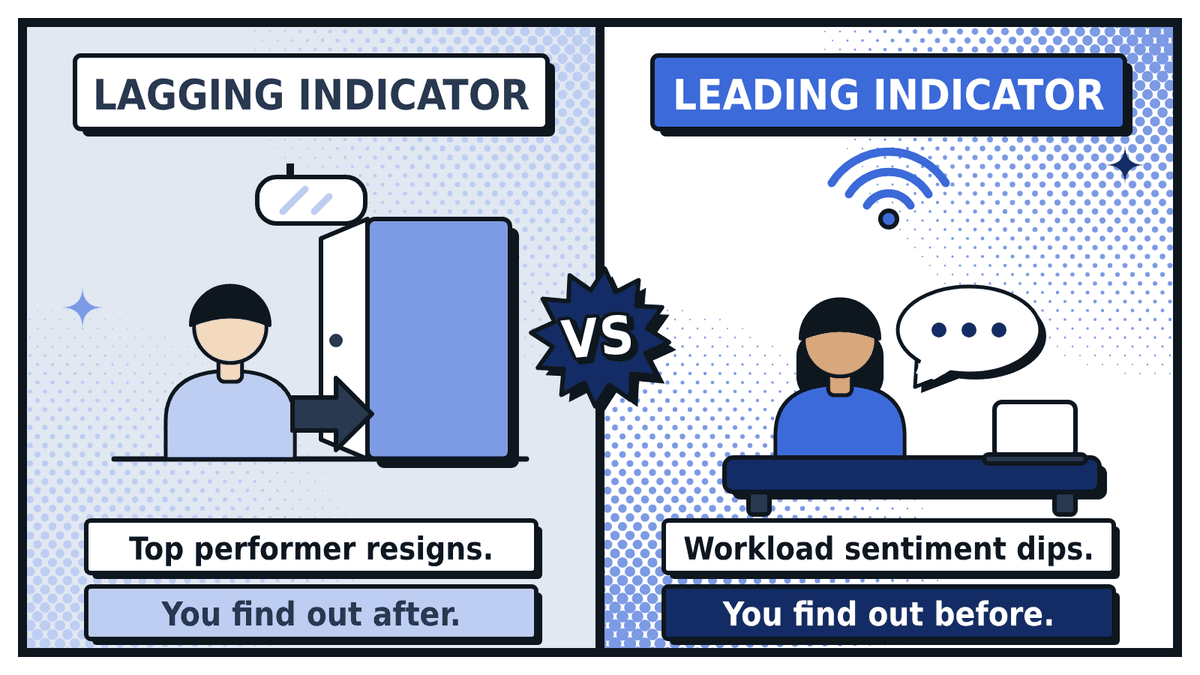
A lagging indicator measures a result after it has happened: revenue, attrition, an annual engagement score. A leading indicator is an early signal that tends to move first and can still be influenced: a shift in team sentiment, a concern nobody answered, a manager who has stopped holding conversations. Kaplan and Norton’s Balanced Scorecard made the pairing famous by arguing that outcome measures should always travel with the drivers that move them.
A lagging indicator is a report on the damage. A leading indicator is the smoke.
Lagging indicators win by default because they are easy to count and audit. The risk is false comfort: a calm number can sit on top of a restless team, and nobody asks a question because the number looks like an answer.
Why Does the Difference Matter? Because Most People Metrics Arrive After the Damage
Most of what HR dashboards show is lagging. Resignations, absence, exit interview findings and last year’s engagement score all describe something that has already happened. By the time they move, the causes are months old.
Take retention. Microsoft’s 2021 Work Trend Index, a survey of more than 30,000 people in 31 countries, found that about 41 percent of the global workforce was considering leaving their employer that year. That intention is a leading indicator. The resignation letter, months later, is the lagging one. A leader who sees the first has time to talk. A leader who waits for the second can only recruit.
Which People Metrics Are Which?
Neither is better. Lagging indicators prove whether your actions worked. Leading indicators show where to act. A leading signal is a prompt for a conversation, not a verdict about a person.
Why Are Leading Indicators So Much Harder to Get?
Because they live in people, not in systems. Payroll can produce attrition by Friday. Nothing produces “a team is quietly losing faith” automatically. Someone has to listen, and people only answer honestly when it is safe to do so. When Google studied its most effective teams in Project Aristotle, psychological safety emerged as the most important factor.
Averages make it worse. In a hypothetical company, the engagement score holds steady while one small team drops sharply, and the early signal is buried in the headline.
How Does Organizational Intelligence Create Leading Indicators, and Where Does Leadbacker Fit?
Organizational intelligence is a company’s ability to learn from its own people, in time for it to matter. It rests on three habits: listening continuously, making sense of what people say, and acting on it visibly. Done well, early signals reach the managers and leaders who can act on them, team by team.
Leadbacker is an AI people-intelligence platform built around this idea. Four capabilities map directly to leading indicators:
Heart Rate Monitor:
tracks team sentiment and compares departments, locations and seniority levels, so a drop in one team shows up before the average moves.
Surveys:
short, targeted questions around milestones and organizational changes, so leaders see how a change lands within weeks.
Development Dialogues:
a regular check-in cadence that keeps manager conversations and their documentation in one place.
My360:
compares how people see themselves with how others see them, an early read on manager effectiveness.
Together they cover the whole chain: how people feel, how a change lands, whether managers are talking, and how they are seen. In Leadbacker’s work, a recurring pattern is that the earliest warnings sit in the gaps between groups. A leader who sees workload sentiment fall in one team can rebalance work before anyone updates a CV.
Start Small: Pair Every Lagging Number With One Leading Signal
Pick one lagging metric you worry about, such as attrition in a single team.
Ask what usually changes three to six months earlier, and track one signal that captures it.
Agree a rule: when that signal moves, someone talks to the team within two weeks.
The test is simple: if your biggest people problem surfaced tomorrow, which signal would have warned you last quarter? Explore how Leadbacker turns employee voice into leading indicators at leadbacker.com.
““What has changed in your work over the last month that I would not see in any report?””
FAQs
What is the difference between leading and lagging indicators? Lagging indicators measure results after they happen, such as attrition or revenue. Leading indicators are early signals that tend to move first, such as shifting sentiment or unanswered concerns. Lagging indicators confirm what happened. Leading indicators give you time to change it.
Are leading indicators always better than lagging ones? No, you need both. Lagging indicators prove whether your actions worked, and leading indicators show where to act. A leading signal without an outcome check can mislead, while an outcome without early signals arrives too late. The strongest approach pairs each outcome you care about with the earliest reliable signal that points to it.
How does Leadbacker help leaders see leading indicators? Leadbacker collects employee feedback continuously, shows sentiment by team, location and seniority, and supports regular manager conversations. Leaders see where signals are moving, talk to the right team early, and track whether their response changed anything. It does not replace judgment, it shows leaders where to look first.
Sources Referenced
Kaplan, R. S., & Norton, D. P. (1992).
The Balanced Scorecard: Measures That Drive Performance.
Harvard Business Review.
Microsoft (2021).
The Next Great Disruption Is Hybrid Work: Are We Ready?
Work Trend Index.
Google re:Work. Project Aristotle (team effectiveness research).